SEO: A Complete Guide to Search Engine Optimization in 2026
In today’s digital world, having a website is not enough. If people cannot find your website on search engines like Google, it becomes difficult to attract visitors, generate leads, and grow your online presence.
This is where SEO (Search Engine Optimization) plays an important role.
SEO is one of the most effective digital marketing strategies for improving a website’s visibility in search engine results and attracting relevant organic traffic.
What Is SEO?
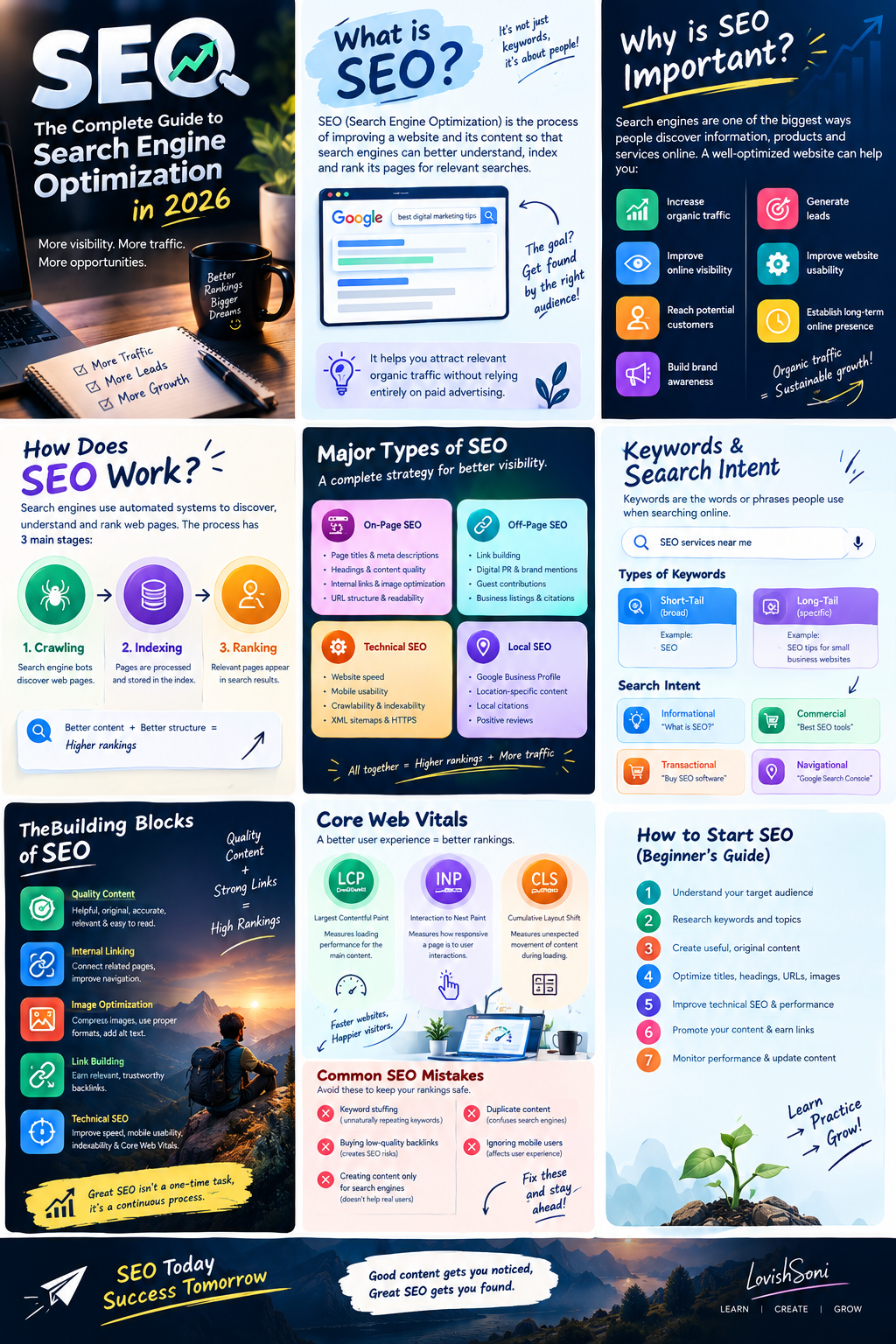
SEO stands for Search Engine Optimization. It is the process of improving a website and its content so that search engines can better understand, index, and rank its pages for relevant searches.
For example, if you have a digital marketing website and someone searches for “best digital marketing strategies”, SEO can help your relevant page appear in search results.
The main goal of SEO is to attract relevant organic traffic without relying entirely on paid advertising.
Why Is SEO Important?
SEO is important because search engines are one of the major ways people discover information, products, services, and businesses online.
A well-optimized website can help businesses:
- Increase organic website traffic
- Improve online visibility
- Reach potential customers
- Build brand awareness
- Generate leads
- Improve website usability
- Establish long-term online presence
Unlike paid advertising, where traffic generally stops when the advertising campaign stops, SEO focuses on building sustainable organic visibility over time.
How Does SEO Work?
Search engines use automated systems to discover and understand web pages. They analyze many signals to determine which pages may be useful and relevant for a particular search.
A simple SEO process can be understood through three major stages:
1. Crawling
Search engines discover webpages using automated programs commonly called crawlers or search engine bots.
2. Indexing
After discovering a page, the search engine processes and stores information about that page in its index.
3. Ranking
When someone performs a search, the search engine uses various signals to determine which indexed pages are most relevant to the query.
SEO helps make your website easier for search engines to understand while also improving the experience for visitors.
Major Types of SEO
SEO can be divided into several important areas.
1. On-Page SEO
On-page SEO focuses on optimizing elements that are present on your website.
Important elements include:
- Page titles
- Meta descriptions
- Headings
- Keywords
- Content quality
- Internal links
- Image optimization
- URL structure
- Content readability
For example, instead of creating a page with a vague title such as “Services”, a more descriptive title could be “Digital Marketing Services for Small Businesses.”
2. Off-Page SEO
Off-page SEO involves activities outside your own website that can contribute to your website’s visibility and authority.
Common off-page SEO activities include:
- Link building
- Digital PR
- Brand mentions
- Business listings
- Guest contributions
- Relevant citations
Backlinks from relevant and trustworthy websites can help search engines discover pages and understand relationships between websites.
However, quality and relevance are more important than simply acquiring a large number of links.
3. Technical SEO
Technical SEO focuses on improving the technical foundation of a website.
Important areas include:
- Website speed
- Mobile usability
- Crawlability
- Indexability
- XML sitemaps
- Robots.txt
- HTTPS
- Canonical URLs
- Structured data
- Core Web Vitals
A technically accessible website makes it easier for search engines to crawl and understand your content.
4. Local SEO
Local SEO helps businesses improve their visibility for searches connected to a specific location.
For example, a user might search for:
“digital marketing agency near me”
or
“SEO services in Chandigarh.”
Businesses can improve local visibility by maintaining accurate business information, creating useful location-specific content, and managing their presence across relevant local platforms.
What Are Keywords in SEO?
Keywords are words or phrases that people use when searching for information online.
Examples include:
- SEO services
- Digital marketing agency
- SEO tips for beginners
- How to improve Google rankings
- Local SEO services
Keyword research helps you understand what your target audience is searching for.
However, keywords should be used naturally. Repeating the same keyword excessively can make content difficult to read and may be considered keyword stuffing.
Types of Keywords
Short-Tail Keywords
These are usually broad and relatively short.
Example:
SEO
Long-Tail Keywords
These are more specific search phrases.
Example:
SEO tips for small business websites
Long-tail keywords can help you create content that addresses a specific search intent.
What Is Search Intent?
Search intent refers to the reason behind a user’s search.
For example:
Informational intent:
“What is SEO?”
Commercial investigation:
“Best SEO tools for beginners”
Transactional intent:
“Buy SEO software”
Navigational intent:
“Google Search Console”
Understanding search intent helps you create content that actually satisfies what the user is looking for.
Importance of Quality Content
Content is a major part of SEO.
A successful SEO strategy should focus on creating content that is:
- Helpful
- Original
- Accurate
- Relevant
- Easy to understand
- Well structured
- Written for people first
Instead of creating content simply to include keywords, focus on answering the questions and problems of your target audience.
For example, a digital marketing website could publish articles about:
- SEO for beginners
- Keyword research
- Link building
- Technical SEO
- Local SEO
- Content marketing
- Google Search Console
- Website optimization
Internal Linking
Internal linking means linking one page of your website to another page on the same website.
For example, a blog about SEO can link to another article about keyword research.
Internal links can help:
- Users discover related content
- Search engines discover pages
- Establish relationships between pages
- Improve website navigation
A good internal linking structure can make your website easier to explore.
Image Optimization
Images can improve the visual quality of a webpage, but large or poorly optimized images can negatively affect page performance.
Some useful image optimization practices include:
- Compressing images
- Using appropriate file formats
- Giving images descriptive filenames
- Adding meaningful alt text when appropriate
- Using responsive images
- Avoiding unnecessarily large image dimensions
For example, instead of an unclear filename such as:
IMG12345.jpg
a descriptive filename could be:
seo-strategy-guide.jpg
Core Web Vitals
Core Web Vitals are metrics used to evaluate important aspects of webpage experience.
Three well-known Core Web Vitals are:
LCP – Largest Contentful Paint
Measures loading performance for the main content of a page.
INP – Interaction to Next Paint
Measures how responsive a page is to user interactions.
CLS – Cumulative Layout Shift
Measures unexpected movement of page content during loading.
Improving website performance can create a better experience for visitors.
Link Building and SEO
Link building is the process of earning or acquiring relevant links from other websites to your website.
Examples include:
- Creating link-worthy content
- Digital PR
- Industry partnerships
- Relevant guest contributions
- Resource pages
- Original research
Avoid focusing only on the number of backlinks. Relevant, natural, and trustworthy links are generally more valuable than large quantities of low-quality links.
Common SEO Mistakes to Avoid
Many beginners make mistakes while implementing SEO.
Keyword Stuffing
Using a keyword excessively can make content unnatural.
Duplicate Content
Publishing substantially duplicated content across pages can create confusion about which page should be shown in search results.
Buying Low-Quality Backlinks
Low-quality or manipulative link-building practices can create SEO risks.
Ignoring Mobile Users
A large amount of web browsing happens on mobile devices, so websites should provide a good experience across screen sizes.
Creating Content Only for Search Engines
Content should primarily help users rather than being written simply to manipulate rankings.
How to Start SEO as a Beginner
If you are new to SEO, follow a simple process:
Step 1: Understand your target audience.
Step 2: Research relevant keywords and topics.
Step 3: Create useful, original content.
Step 4: Optimize titles, headings, URLs, images, and internal links.
Step 5: Improve technical SEO and website performance.
Step 6: Promote your useful content and earn relevant mentions and links.
Step 7: Monitor your performance and update content when necessary.
SEO is not a one-time activity. Search technology, user behavior, competitors, and websites continue to change, so SEO requires continuous improvement.
Conclusion
SEO is an essential part of building a strong online presence. From keyword research and content creation to technical optimization, internal linking, and link building, every part of SEO contributes to making a website more discoverable and useful.
The most effective approach is to focus on users first, useful content, strong technical foundations, and sustainable optimization practices.
Whether you are a beginner, blogger, business owner, or digital marketer, learning SEO can help you understand how websites gain organic visibility and how search engines connect users with relevant information.
Keep learning, keep optimizing, and keep creating value for your audience.


Leave a Reply